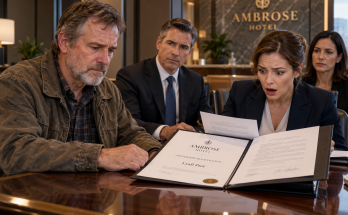
William Ross stared at Rachel as though she had accused him of inventing gravity.
“My prescription?”
Rachel kept her finger on the copied authorization number.
“Yes.”
“That’s impossible.”
“Why?”
“I haven’t used Harrison’s pharmacy in years.”
“Your name wouldn’t need to be on the bottle.”
William stopped.
Rachel pulled the pharmacy logs closer.
“Authorization numbers aren’t random. This prefix belonged to a private prescribing arrangement my father used for patients whose identities required additional confidentiality.”
Victor looked at William.
“You were one of Samuel Price’s patients.”
William said nothing.
Elizabeth turned toward her father.
“Were you?”
“Briefly.”
“How briefly?”
“Several years.”
“While we believed you were dead.”
“Yes.”
Her expression hardened.
“Of course.”
Rachel continued.
“Richard’s medication and William’s were similar enough that someone could use one record to generate the other without immediately triggering an audit.”
I looked at the pharmacy pages.
“So the forged order began with William’s chart.”
“Yes.”
“But Dad took the pills.”
“Yes.”
“Meaning whoever designed this might have intended William to receive them.”
“Originally.”
William lowered himself into the nearest chair.
For the first time since meeting him, he looked genuinely old.
“Martin knew.”
Rachel looked at him.
“Knew what?”
“That Samuel treated me.”
“How?”
“Martin arranged the first appointment.”
Marian whispered, “Why would he?”
“Because I couldn’t use my real insurance.”
Martin again.
The man seemed to have spent half his life creating the secret channels that later trapped everyone inside them.
Victor pointed at Harrison’s photograph.
“Then why is the pharmacist kidnapping Margaret?”
“Maybe kidnapping is the wrong word,” Helen said through the phone.
We had called her as soon as Harrison’s face appeared.
“What do you mean?” I asked.
“Margaret doesn’t look restrained.”
I zoomed in.
Her hands were visible.
No rope.
No tape.
She sat rigidly, but Margaret always looked as though furniture had offended her.
Victor said, “Someone can be captive without restraints.”
“True.”
Helen continued.
“But look at Harrison.”
He stood several feet behind her.
No weapon.
No obvious threat.
The photograph might have been staged.
Margaret could have participated.
“Why would she?”
Victor’s voice sounded less certain now.
Helen answered.
“To make us bring the master schedule somewhere.”
William looked at me.
“Don’t.”
“I wasn’t planning to.”
Victor snapped, “That’s my mother.”
“And this document controls evidence involving hundreds of people.”
“She could be killed.”
Elizabeth said, “So could George if he walks into whatever they arranged.”
Victor looked at her.
“You’d choose the ledger over Margaret?”
My mother’s expression did not change.
“I’d choose not to pretend those are the only choices.”
Anna would have liked that answer.
I wished she were with us instead of back at the house.
I called her.
She answered immediately.
I explained Harrison.
The photograph.
William’s prescription number.
The demand.
Anna listened without interrupting.
Then asked, “What does Harrison want from the schedule?”
“Maybe his name removed.”
“Then he’d destroy it, not request it.”
“So?”
“Maybe he wants something the schedule points to.”
I looked at William.
“What does it point to?”
“Accounts.”
“Specific locations?”
“Some.”
“B-17?”
“Yes.”
“Could Harrison access it?”
“No.”
“Could Margaret?”
William hesitated.
“Possibly.”
Victor turned.
“How?”
“Edward gave her authority over one branch before he died.”
Margaret and Harrison might need the schedule together.
One had access.
One knew the medical evidence.
That made the photograph look different.
Not captor and captive.
Partners.
Rachel took the contaminated vial from the evidence bag.
“Could Harrison have faked his death because he knew Richard’s death would eventually be investigated?”
Helen answered.
“His obituary appeared eleven months ago. Richard died three years ago.”
“So he stayed visible for two years.”
“Yes.”
“Then disappeared when?”
Helen searched.
“Shortly after Martin’s cancer became terminal.”
Marian looked up.
“That matters.”
“Why?”
“Martin began contacting people once he knew he was dying.”
Anna.
Daniel.
Possibly Harrison.
Maybe Harrison realized Martin intended to confess.
“Did Martin contact him?” I asked.
Marian searched her memory.
“There was a number.”
“What number?”
“Martin kept calling a prepaid phone during his final months. He labeled it H.C.”
Helen said, “I can trace billing records if they still exist.”
“Do it.”
William looked toward the cemetery.
“We shouldn’t stay here.”
He was right.
Too many people now knew the box had been opened.
We photographed every page of the master schedule.
Then we did something Margaret, Victor, and Richard would have considered sacrilege.
We made copies.
Several.
One set went with Rachel.
One with Elizabeth.
One with Marian.
The original stayed with me.
Victor objected.
I handed him a copy too.
That silenced him.
“Why give me one?”
“Because secrets are what got us here.”
He stared at the pages.
“That’s either brave or stupid.”
“Probably both.”
We left the cemetery separately.
Harrison’s instructions arrived thirty minutes later.
A text from Margaret’s phone.
OLD BENNETT OFFICES. 4 P.M. GEORGE ONLY. MASTER SCHEDULE.
Victor immediately said no.
Elizabeth said it louder.
I asked Helen to pull building information.
The old Bennett offices had been abandoned after Dad consolidated operations.
Five floors.
Underground records room.
Two entrances.
Victor still had access codes.
“Cameras?” I asked.
“Disconnected.”
“Convenient.”
Rachel examined the photograph again.
“Harrison may not know we discovered William’s connection to the prescription.”
“So we use that.”
“How?”
“Bring William.”
William laughed.
“No.”
I looked at him.
“You told me not to go.”
“Yes.”
“So you go instead.”
“I’m eighty-seven.”
“You’ve been dead for years. Surprise has to count for something.”
For the first time, Daniel smiled.
William did not.
But he agreed.
At 3:40 we reached the Bennett offices.
Not alone.
Victor entered through the underground garage.
Daniel waited in a neighboring building.
Helen monitored from a vehicle.
Elizabeth refused to remain farther than one block away.
Rachel carried the vial and pharmacy records.
William sat beside me.
I held a briefcase containing nothing but blank paper.
The master schedule remained elsewhere.
At 3:58 we entered the lobby.
Dust covered the marble floor.
The Bennett logo still hung behind reception.
Dad had once brought me here as a child.
I remembered spinning in the leather chairs while adults discussed numbers I did not understand.
Now those numbers had become graves.
“Elevator won’t work,” William said.
We took the stairs.
Fourth floor.
Former executive conference room.
Door open.
Margaret sat at the table.
Harrison Cole stood beside the window.
He looked exactly like the photograph.
Thin.
Gray.
Alive.
Margaret saw William.
Her composure vanished.
“You.”
William leaned on his cane.
“Disappointed?”
“I watched them bury you.”
“Apparently funerals in our circle lack reliability.”
Harrison looked at me.
“You were told to come alone.”
“I inherited poor listening skills.”
His eyes moved to William.
Then widened.
“You’re alive.”
William smiled.
“So are you.”
Margaret stood.
“George, give Harrison the schedule.”
“Why?”
“Because this ends if you do.”
“No.”
Her jaw tightened.
I looked at Harrison.
“Did you poison my father?”
“No.”
“Did you prepare the altered medication?”
“Yes.”
Rachel stepped into the doorway behind us.
Harrison’s face changed.
“You.”
Rachel held up the pharmacy records.
“You used my credentials.”
Harrison shook his head.
“I filled an authenticated order.”
“You knew it was false.”
“Not initially.”
“When did you know?”
“After Martin came to me.”
“Before Dad died?”
“Yes.”
“So you knew dangerous medication had been dispensed.”
“Yes.”
“And didn’t report it.”
“Martin told me he was handling it.”
Rachel laughed once.
“Martin was the lawyer for half the criminals involved.”
Harrison looked ashamed.
“I know that now.”
“Did Martin order the medication?”
“No.”
Every person in the room froze.
Marian’s copied records had pointed toward Martin.
The fax.
The initials.
The payments.
“Who did?” I asked.
Harrison looked at Margaret.
She did not react.
Then he looked at William.
“It was ordered for him.”
“That’s not who ordered it.”
“No.”
“Then answer.”
Harrison swallowed.
“The authorization came from Samuel Price’s private system.”
Rachel said, “Using my credentials.”
“Yes.”
“Who supplied the template?”
“Marian delivered a sealed packet.”
Marian had admitted that.
“Who gave her the packet?”
“Martin.”
“Then Martin.”
Harrison shook his head.
“Martin didn’t create it.”
“How do you know?”
“Because when he discovered what was inside, he came back furious.”
That changed everything.
Martin had used Marian as courier without knowing the sealed packet contained forged medical authorization.
“Who gave Martin the packet?”
Harrison looked at Margaret again.
She finally spoke.
“Tell him.”
Harrison’s face tightened.
“Louise Carter.”
Marian’s dead mother.
I stared.
“Louise was dead long before Dad.”
“Yes.”
“So impossible.”
“Not if the packet had been prepared years earlier.”
Rachel understood first.
“A standing contingency.”
Harrison nodded.
Louise had created documents allowing a medication order to be generated later under certain conditions.
Not poison.
At least not originally.
“What condition?”
Harrison looked at William.
“If William Ross resurfaced.”
William gripped his cane.
“My medication.”
“Yes.”
“Why?”
“Louise believed you were dangerous.”
William laughed.
“She helped me disappear.”
“She regretted it.”
Marian had said Louise discovered how her legal work enabled lies.
Apparently she had also prepared protection against William returning.
“What was the original prescription supposed to be?” Rachel asked.
“A sedative.”
“For what?”
“To incapacitate him temporarily.”
Rachel’s face hardened.
“That alone could have been dangerous at his age.”
“I know.”
“But someone altered the formulation.”
“Yes.”
“Who?”
Harrison looked toward Margaret.
She said nothing.
Then Harrison whispered:
“Richard.”
I felt as if the floor shifted.
“My father altered the order?”
“Yes.”
“Why would Dad poison William?”
William’s face had gone white.
Harrison answered.
“Because Richard found out William was alive.”
Silence.
“He wanted to force him out.”
“With poison?”
“No. Richard replaced Louise’s sedative order with something intended to produce symptoms William would recognize as deliberate.”
Rachel looked disgusted.
“He weaponized medication to frighten him.”
“Yes.”
“Then how did Dad end up taking it?”
Harrison looked at Margaret.
This time she answered.
“Because I switched the patient.”
Victor stepped from the side doorway.
His mother turned.
He looked at her as though she were a stranger.
“You did what?”
Margaret closed her eyes.
“I redirected the prescription from William to Richard.”
Nobody spoke.
“Why?”
“Because Richard was dismantling everything.”
Victor whispered, “Mother.”
“He was going to expose all of us.”
“So you poisoned him.”
“No.”
“You just admitted—”
“I intended to frighten him.”
The same excuse.
The same inherited logic.
William had hidden people.
Richard had threatened people.
Margaret altered medicine.
Everyone claimed the harm was supposed to stop one step before death.
Rachel asked, “Did you understand the cardiac risk?”
Margaret looked at her.
“Yes.”
“Then you knew he could die.”
“Yes.”
That was enough for me.
Harrison interrupted.
“But Margaret didn’t make the final switch.”
I stared.
“What?”
“She redirected the prescription.”
“Yes.”
“She did not place the contaminated bottle in Richard’s house.”
“Who did?”
Harrison looked toward the conference-room door.
Footsteps sounded outside.
Slow.
Measured.
A woman entered.
Caroline.
Elizabeth’s sister.
She looked at William.
Then Margaret.
Then me.
“I did.”
Click here to continue reading: PART 26: Caroline Admitted Carrying the Altered Medicine Into Richard’s House, but Her Reason Exposed the Trap Martin Had Built Around Margaret’s Plan
On My Twenty-Fifth Birthday, the Woman I Had Hated for Twelve Years Returned With a Gift My Father Never Wanted Me to Open
Part 25 of 40