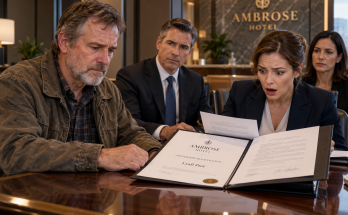
Maya waited until I had read Jessica’s signature twice before closing the folder.
The date remained in my head.
Four months after our wedding.
Not four months after Caroline’s recent letters. Not after the money. Not after Dad began asking questions.
Jessica had gone looking for my adoption records when our marriage was still new enough that we were writing thank-you cards from the wedding.
“Why would she request them?” I asked.
“That’s what I want to know.”
“Could she legally do that?”
“Not the full sealed record. But she requested copies from Arthur’s personal file through a records service.”
I frowned.
“Dad gave permission?”
“No.”
My eyes moved toward the room where he slept.
“Then how did she get anything?”
“Arthur kept duplicates with an attorney who handled some estate work for him years ago. Jessica apparently represented herself as acting on your behalf.”
The sentence landed harder than I expected.
“She pretended I asked for them.”
“Yes.”
“And nobody called me?”
“Apparently not.”
I paced to the window.
The hospital parking lot below was almost empty now. Pools of yellow light lay across wet pavement.
“What exactly did she get?”
“Most of Arthur’s copies.”
“Most?”
Maya opened the folder again.
“There’s a gap in the numbering.”
She showed me photocopied pages.
One through six.
Then eight through eleven.
Page seven was absent.
“That could be nothing.”
“It could.”
“But you don’t think it is.”
“No.”
“Why?”
“Because Arthur’s handwritten inventory from years ago lists twelve pages.”
“Twelve?”
Maya nodded.
“One page is missing from the set Jessica requested. Another page is missing from Arthur’s current copy.”
“Which pages?”
“Seven and twelve.”
I stared at her.
“Could Dad have lost them?”
“Possibly.”
“Could Jessica have taken them?”
“Possibly.”
I was growing tired of that word.
I went back into Dad’s room.
His eyes opened as soon as I touched his hand.
“Dad.”
He looked at me.
“Maya found the old adoption file.”
His brow tightened.
“Jessica requested copies years ago.”
The monitor beside him continued its steady rhythm.
“She pretended I asked for them.”
Dad closed his eyes.
“You knew.”
His eyelids lifted again.
“When?”
He swallowed.
“Later.”
“How much later?”
“Last year.”
I pulled the chair closer.
“How?”
“Couldn’t find page.”
“Which page?”
His lips moved.
“Twelve.”
Maya stepped nearer.
“Arthur, do you remember what page twelve contained?”
He nodded.
“What?”
Dad’s voice was weak.
“Letter.”
“What letter?”
“Caroline’s father.”
I looked at Maya.
She leaned forward.
“What did it say?”
Dad closed his eyes as if reaching back through decades.
“That baby… wasn’t abandoned.”
My chest tightened.
“Dad, I know Caroline didn’t abandon me.”
He shook his head.
“Not that.”
“What then?”
“Father.”
“My biological father?”
Dad nodded.
I had barely thought about him.
Caroline had consumed every available corner of the day.
“Who was he?”
Dad looked frightened.
“I don’t know.”
“You said there was a letter.”
“Name removed.”
“Removed?”
He lifted his fingers weakly.
“Blacked out.”
Maya asked, “Did the letter say why?”
Dad swallowed.
“Danger.”
I felt irritation rising.
“Danger from whom?”
Dad’s breath quickened.
The nurse came in almost immediately.
“That’s enough.”
“I need one more answer.”
“No.”
She checked his monitors.
“His heart rate is climbing. He needs rest.”
Dad’s fingers tightened around mine before I stood.
“Kitchen,” he whispered.
I leaned closer.
“What?”
“At home.”
“Your house?”
He nodded.
“Where?”
“Flour.”
I stared at him.
“Flour?”
His eyes closed.
The nurse motioned toward the door.
Maya and I stepped into the corridor.
“Did he say flour?”
“Yes.”
She almost smiled.
“Then perhaps Arthur has been hiding things in his kitchen.”
It sounded absurd.
Then I remembered Dad’s habits.
He kept receipts in coffee tins.
Spare keys inside old jars.
Cash behind the freezer drawer.
He distrusted anything labeled secure but trusted places nobody would think to search.
“I need to go to his house.”
“Not alone.”
“I’m not going back to mine.”
“I agree.”
Caroline was asleep in a waiting-room chair when we found her.
I touched her shoulder.
She woke immediately.
“Arthur?”
“He’s stable.”
She exhaled.
“We need to check his house.”
“I’ll come.”
Maya tried to discourage her.
Caroline refused.
“I’ve spent enough years waiting for somebody else to tell me what happened.”
We drove separately.
Dad’s house stood fifteen minutes from the hospital in a quiet neighborhood of aging ranch homes and enormous trees.
I had a key.
The front room smelled exactly as it always had—wood polish, coffee, and the faint trace of the menthol rub Dad used on his knees.
For a few seconds I could not move.
Everything in the house belonged to the version of my childhood I had understood.
My school photographs lined the hallway.
A clay handprint from kindergarten hung beside the kitchen door.
The refrigerator still had a magnet from a road trip we took when I was twelve.
None of those memories had changed.
Only the explanation beneath them had.
Maya went directly to the kitchen.
“Flour.”
Dad had one large ceramic container beside the stove.
I lifted the lid.
Flour.
Nothing else.
Caroline watched me dig through it with a wooden spoon.
“No?”
“No.”
We searched the pantry.
Three more bags of flour sat on a shelf.
The second was unopened.
The third had been folded shut with a clothespin.
I lifted it.
Too heavy.
Inside was a sealed plastic pouch.
My hands stopped.
Maya put on disposable gloves from her bag.
“You carry gloves?”
“I’m an attorney.”
That somehow explained nothing and everything.
She removed the pouch.
Inside were papers.
One had a large handwritten number at the top.
12.
I sat at Dad’s table.
The page was not an official adoption form.
It was a letter.
Dated thirty-four years earlier.
The author was Thomas Whitmore.
Caroline’s father.
Caroline moved beside me.
“My father.”
Her voice became flat.
The letter was addressed to a lawyer named Gerald Pike.
It instructed Pike to proceed quickly.
Caroline was still hospitalized after an automobile accident.
Thomas wrote that she was emotionally unstable and would eventually understand the decision had been necessary.
The child was to be placed permanently.
No contact.
No future disclosures.
Then came the sentence Dad had remembered.
The child’s biological father must never be informed.
The name following that line had been covered in thick black ink.
Caroline stared at it.
“I never told my father who he was.”
I looked at her.
“You knew?”
“Yes.”
“Then who?”
Her eyes shifted toward Maya.
“I haven't said his name in thirty-four years.”
“Why?”
“Because he was married.”
I said nothing.
Caroline sat across from me.
“I was nineteen.”
Her hands folded around each other.
“He was twenty-seven. He worked for my father.”
“Did he know about me?”
“Yes.”
“Did he know you were pregnant?”
“Yes.”
“Did he know I was born?”
Her silence answered first.
“Yes.”
“Then why didn’t he come?”
“He tried.”
I felt something cold move through me.
“How do you know?”
“He called the hospital.”
She looked at the letter.
“My mother told me later that someone came asking about me while I was unconscious.”
“Who?”
“I assumed it was him.”
“What happened?”
“They turned him away.”
Maya pointed to the bottom of the letter.
“There’s more.”
Another paragraph instructed Pike to ensure Arthur Hayes believed both biological parents had relinquished the child.
Dad had been lied to from the beginning.
Caroline pressed both palms flat against the table.
“My father arranged this.”
“Looks that way,” I said.
“He told me my baby died.”
Her voice changed.
It became quieter.
That frightened me more than anger.
“He let me grieve a living child.”
Maya turned the page over.
Nothing.
“Where is page seven?”
I asked.
We searched the pouch.
No page seven.
But there was another object.
A key.
Small.
Brass.
A label was taped to it.
BOX 214.
“Safe-deposit box?” I asked.
“Likely,” Maya said.
Caroline pointed toward another paper.
A bank name.
Evergreen Federal.
I recognized the branch.
Dad had used it for decades.
The next morning Maya contacted the bank.
Because Dad was incapacitated, access would require either his authorization or proof that I was legally permitted under his power-of-attorney documents.
He had named me.
Of course he had.
Dad had trusted me with everything except the truth about where I came from.
By noon, we were standing inside a small private room at Evergreen Federal.
The employee brought box 214.
Inside were three things.
A stack of old photographs.
A cassette tape.
And page seven.
Maya laid it on the table.
Unlike page twelve, page seven contained a signature.
A man had signed a voluntary surrender document stating that he relinquished paternal rights to an infant male.
The name was visible.
Daniel Mercer.
Caroline made a sound behind me.
I turned.
She had gone pale.
“That isn’t him.”
Maya looked up.
“What?”
“That man is not Ethan’s father.”
“Are you certain?”
“Yes.”
“Who is Daniel Mercer?”
“I don’t know.”
The signature had been notarized.
Gerald Pike.
The same attorney who handled the placement.
“Then this document is false,” I said.
Caroline stared at the page.
“Yes.”
Maya photographed everything.
I picked up the cassette.
A handwritten label read:
T.W. / G.P. — 1992.
“Thomas Whitmore and Gerald Pike?”
Caroline nodded.
The bank employee found an old cassette player from a storage room.
It took several tries before the tape moved.
Static filled the room.
Then a man spoke.
I had never heard my grandfather’s voice.
Caroline recognized it immediately.
“My father.”
Thomas Whitmore sounded impatient.
He told Gerald Pike the situation had to disappear before Caroline recovered enough to ask questions.
Pike warned him that forging a paternal surrender created risk.
Thomas replied that the real father had already threatened to pursue custody.
Caroline covered her mouth.
I looked at her.
“Who was he?”
She did not answer.
On the tape, Pike asked whether Thomas was certain Arthur would cooperate.
Thomas laughed.
“He wants the boy.”
Then he said something that changed my understanding of Dad again.
Arthur had not simply been handed a random abandoned baby.
Thomas had chosen him.
Why?
Because Arthur was young, unmarried, loyal, and easy to frighten.
Pike asked what would happen if Caroline discovered the truth later.
Thomas answered that by then Arthur would be too attached to surrender the child.
Dad had been manipulated through love before he even understood what was happening.
Then Pike asked the question I had been waiting for.
“And the real father?”
Thomas answered with a name.
The audio crackled.
A truck passed outside the bank.
I leaned toward the speaker.
The name repeated.
This time I heard it.
Michael Grant.
Caroline closed her eyes.
“Yes.”
I stared at her.
“That’s him?”
“Yes.”
“Where is he?”
She opened her eyes.
“I don't know.”
Maya was already typing into her phone.
“I can find out.”
The tape continued.
Thomas said Michael had been given money to leave town.
Pike asked whether Michael accepted it.
Thomas said no.
Then there was a long pause.
Pike asked, “So what did you do?”
Thomas answered.
“I made sure he understood there would be consequences if he came near Caroline again.”
The recording ended.
We sat in silence.
My biological father had not abandoned me.
My mother had not surrendered me.
Arthur had not knowingly taken me from either of them.
Every adult at the center of my birth had been pushed apart by one man.
Caroline’s father.
Then Maya’s phone vibrated.
She looked at the screen.
Her expression changed.
“What?”
“I ran a preliminary public-record search.”
“And?”
“Michael Grant is alive.”
Caroline stopped breathing for a second.
I stood.
“Where?”
Maya looked from her to me.
“He lives less than thirty miles from here.”
Click here to continue reading: PART 6: My Biological Father Had Lived Half an Hour Away for Decades, but His First Question Proved He Never Stopped Looking
The Thousand Dollars My Father Could Barely Ask For Became the First Crack in Everything I Thought I Knew
Part 5 of 24