By the time autumn reached the hills, the evidence room no longer looked like a mystery waiting to be solved.
It looked like work.
Boxes had numbers. Recordings had transcripts. Bank transfers had dates and authentication reports. Investigators had stopped drawing dramatic arrows between photographs because the relationships were no longer theories. They were transactions, calls, meetings, signatures, threats, medical records, and statements that could be tested against one another.
Sheriff Mercer invited Dad and me to her office on a gray Monday morning.
She had warned us that the meeting would not contain another revelation.
Dad said, “I’ll believe that when I leave.”
Mercer almost smiled.
“I mean it.”
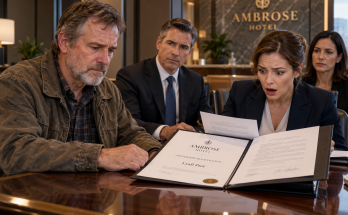
On her table sat a thick binder.
FINAL RECONSTRUCTION — ELEANOR COLE.
Seeing Mom’s name on something called final made me uneasy.
Nothing about her felt final.
Mercer opened the binder.
“This is not a prosecution memo. Different cases are still moving. This is our best evidence-based reconstruction of what happened to Eleanor and the events directly surrounding her death.”
Dad nodded.
“No theories?”
“Where something remains uncertain, it says uncertain.”
“Good.”
That had become his favorite word in investigations.
Not guilty.
Not innocent.
Uncertain.
A place where facts could remain until evidence moved them.
Mercer began with the afternoon before Mom died.
Henry visited her at 3:11.
He demanded the torn page and threatened me indirectly.
Mom refused.
She called Harold.
Then went to Wren.
Then Denise Porter.
Then the reservoir.
She created the independent cache.
She returned home planning to tell Dad everything the next morning.
That part was established.
The following day, Grant and Vanessa arrived.
The financial confrontation escalated.
Grant wanted evidence and money.
Vanessa had already begun wavering between participation and escape.
Diane’s medication alteration had made Mom physically vulnerable.
Harold faked chest pains to remove Dad.
Dad drank the sedative Harold gave him.
Harold later brought Dad home briefly.
Mom asked him not to leave.
Everyone around him told him she was confused.
He left again.
Dad stared at the table.
Mercer did not soften the sequence.
Neither did she linger on it.
Then Grant took the syringe Harold had prepared.
Harold tried briefly to stop him.
Failed.
Stepped back.
Grant injected Mom.
Vanessa did not stop him.
Mom deteriorated.
Grant called Mallory.
Mallory ordered them to secure medication and evidence before summoning help.
The delay continued.
Henry arrived searching for the page.
Vanessa found it.
Henry invoked Claire.
Vanessa surrendered it.
Eventually she called 911.
Mom died.
Those were the facts.
Dad whispered, “And Calder?”
“Thomas Calder helped build the system that made all of those people dependent on one another. We have evidence of his historical corruption. We do not have evidence that he personally ordered Eleanor killed that night.”
“And Evan?”
“Evan surveilled Eleanor, pressured people, knew she was dangerous to the network, and participated in the cover-up afterward. We have evidence supporting additional conduct under investigation. But the evidence does not show him giving Grant the order to inject her.”
Dad nodded.
“Mallory?”
“Ordered the emergency delay after knowing Eleanor was alive.”
“Harold?”
“Created the circumstances, brought the syringe, drugged you, participated in concealment, and failed to get her help when he could have.”
“Vanessa?”
“Participated in financial wrongdoing, helped mislead you, failed to intervene, delayed truth afterward, and surrendered evidence under threat to Claire. She also preserved evidence at other points and later attempted to reach Turner.”
“Diane?”
“Altered medication and participated in the broader medical-record scheme. Her exact knowledge of Grant’s intended use of the syringe remains disputed.”
“Henry?”
“Threatened Eleanor, came for the page while she was alive, threatened Vanessa through Claire, and concealed evidence. Additional cases are separate.”
Dad looked at me.
Then back at Mercer.
“And Grant killed her.”
“Yes.”
No qualifying phrase.
No larger conspiracy used to hide the simplest fact.
Grant injected Mom.
Other people created the room in which he did it.
Other people helped him afterward.
But he made that choice.
Dad asked, “Did Eleanor’s death begin as a planned murder?”
Mercer shook her head.
“The evidence does not establish a single prearranged plan to murder her that night.”
That mattered.
The truth was uglier than a neat assassination.
A group of people arrived with overlapping crimes, fear, greed, secrets, and plans to control Mom.
Then the situation escalated.
At each stage someone could have stopped.
Nobody did soon enough.
Dad looked toward the binder.
“So everybody kept waiting for somebody else to be the decent person.”
Mercer considered it.
“That’s not language I would put in a report.”
“But?”
“But it is consistent with what happened.”
Dad sat back.
For months, he had searched for the person who could carry the whole weight.
Grant.
Harold.
Mallory.
Evan.
Thomas.
A single villain would have been easier.
There wasn’t one.
There were people with different degrees of responsibility who repeatedly made choices that supported one another.
Mercer turned to the false-death call.
Vanessa and Grant had used it to determine whether Dad was with me and what he had told me.
They were panicking after the blocked $38,000 transfer.
Grant feared Dad had found evidence.
Mallory wanted money.
Evan wanted the corporate structure protected.
Harold was attempting to retrieve Mom’s hidden material.
The false death was not a legal scheme sophisticated enough to steal Dad’s estate overnight.
It was a probe.
Cruel.
Desperate.
And badly conceived.
Dad said, “Vanessa should have known Natalie would call someone.”
“I did.”
“You yelled at her first.”
“That too.”
He looked at Mercer.
“And if I hadn’t been there?”
“Natalie likely would have learned quickly that you were alive.”
Dad nodded.
That was another correction worth making.
The morning had felt like a perfect trap when it happened.
It wasn’t.
It was sloppy.
Fear made it seem larger.
The conspiracy had survived for years not because everyone inside it was brilliant, but because people controlled records, frightened witnesses, exploited trust, and benefited from others assuming official documents were reliable.
Once independent evidence began overlapping, the structure weakened rapidly.
Dad looked at Mom’s binder.
“She understood that.”
“Yes.”
Mom had not needed a genius plan.
She needed copies.
Independent witnesses.
Outside records.
Specific claims.
She wrote down what she knew and labeled what she only suspected.
That discipline survived her.
Mercer closed the binder.
“There is one unresolved question.”
Dad groaned.
“You promised.”
“I promised no new mastermind.”
“What question?”
“Why Eleanor did not tell you sooner.”
Dad frowned.
“That isn’t a police question.”
“No.”
“Then leave it unresolved.”
Mercer nodded.
“I intended to.”
That surprised him.
For months, everyone had dissected Mom’s choices because dead people could not object.
Dad had finally reached the point where he did not need every private hesitation converted into evidence.
Mom had been afraid.
She had made mistakes.
She had kept secrets too long.
She had planned to correct them.
Then she ran out of time.
That was enough.
Before we left, Mercer gave Dad a copy of the reconstruction cleared for family access.
He took it reluctantly.
“What am I supposed to do with this?”
“Whatever you want.”
“Can I put it in a drawer?”
“Yes.”
“Can I never read it again?”
“Yes.”
“Finally, a government process I understand.”
Mercer smiled.
Outside, Dad asked if I wanted lunch.
We went to a diner Mom used to like.
He ordered bacon.
I watched him steal one strip from my plate.
“You have your own.”
“Yours is crispier.”
“It came from the same kitchen.”
“Different life experience.”
I slapped his hand away.
He laughed.
Then he stopped.
Across the restaurant, a television showed courthouse footage.
Grant.
Orange uniform.
Attorneys.
No sound.
Dad stared.
I reached for the remote mounted near our booth and turned the television off.
The waitress looked over.
“Sorry,” I said.
She shrugged.
Dad said, “You didn’t have to.”
“I wanted lunch.”
He nodded.
So we ate lunch.
Later that week, Wren completed another stage of the asset reconstruction.
Dad recovered money.
More than he expected.
Less than the theoretical value of everything taken or diverted.
Some assets could not be cleanly separated.
Some would remain tied up for years.
Dad refused to make recovery another obsession.
He paid his legal bills.
Repaired the house.
Set aside money for Claire.
Then he asked Wren how to create a fund for families harmed by the illegal dumping.
Wren warned him not to act impulsively.
Dad said, “I’ve been thinking about it for three months.”
“That qualifies as impulsive for you financially.”
Dad told him to draft options.
He did not call it redemption.
The money had been his.
Some of it had been used without his knowledge inside a system that hurt people.
He wanted part of what came back to do something useful.
That was all.
Vanessa eventually received a resolution reflecting both her admitted conduct and cooperation.
Dad attended the proceeding.
Claire sat beside him.
I sat on his other side.
Vanessa turned once.
Dad did not smile.
He did not look away.
Afterward, Claire asked whether he wanted to speak to her.
“Not today.”
Claire nodded.
No one pushed.
Grant’s legal proceedings took longer.
His cooperation helped investigators.
It did not erase Mom.
It did not erase Lucas.
It did not erase threats.
Dad continued corresponding with him.
Not frequently.
Short letters.
Weather.
The garden.
A book Dad read.
Never pretending Grant was away on a trip.
Never pretending prison was an accident that happened to him.
One day I asked why he wrote.
Dad said, “Because I’m his father.”
Another day I asked whether writing made things harder.
“Yes.”
“Then why?”
“Because easier isn’t always the point.”
I left it there.
Harold wrote too.
Dad returned the first three letters unopened.
He read the fourth.
Then nothing for a month.
Finally, he wrote one sentence back.
I believe you are sorry. I am not ready to decide what that means for us.
Harold never answered.
Maybe for once he understood a boundary.
The old funeral home was sold.
The hunting farm became part of asset litigation.
The lake cabin remained an evidence property.
The quarry underwent environmental remediation.
Lucas Bell’s mother visited once while crews worked.
She stood at the fence.
No cameras.
No speeches.
Just watched excavators remove contaminated soil from the place that had swallowed years of truth.
Rebecca Sloan stood beside her.
I learned about it from Mercer.
I was glad they had gone without us.
Not every consequence belonged to the Cole family.
Peter Lawson’s widow received formal acknowledgment that his concerns had been credible.
Daniel Reeves’s investigative work was incorporated into environmental cases.
Leah published nothing immediately.
That surprised everyone.
She said the prosecutions needed evidence more than she needed a byline.
Michael Turner called that maturity.
Leah told him not to ruin it.
Life returned in pieces.
Dad replaced the kitchen light.
I took the music box home after evidence released it.
The hidden compartments remained open.
I considered repairing them.
Then didn’t.
I put the box on a shelf exactly as it was.
One evening, I wound it.
The melody sounded thin and slightly out of tune.
Mom had loved it anyway.
The Secret Garden was beyond repair.
Grant had torn too much from the center.
The evidence team returned the damaged cover and surviving pages.
Dad asked what I wanted to do with it.
I kept it.
Not because it still hid anything.
Because now it didn’t.
That seemed important.
Click here to continue reading: PART 26: Dad Returned to the Kitchen Where the Lie Began, and Vanessa Finally Told Him What She Had Meant to Say That Morning
My Sister Announced Our Father’s Death Before Breakfast, but the Man Eating Across From Me Had Other Plans
Part 25 of 27