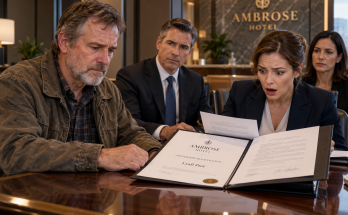
Renata’s cooperation meeting lasted almost six hours.
I was not present.
Celeste was.
By then, prosecutors had enough evidence that Renata could no longer plausibly describe herself as a woman trapped by other people’s crimes.
The forged power of attorney.
The manufactured incompetence record.
The identity theft.
The land transactions.
The messages.
Harold’s recovered recordings.
Her own instruction to Melissa after the crash.
Get rid of the car tonight.
Renata could negotiate only by offering something prosecutors did not already have.
She tried.
Her first strategy was predictable.
Melissa had started everything.
Melissa stole my identity in 2004.
Melissa manipulated the land trust.
Melissa drove the SUV.
Melissa removed Harold’s folder.
Melissa concealed the vehicle damage.
Some of that was true.
Truth can be an effective disguise when arranged selectively.
Then Renata blamed Travis.
He had pressured them over debt.
He controlled the private lender.
He threatened Harold.
He followed Melissa.
He struck Harold’s truck.
He told everyone to stay quiet.
Some of that was probably true too.
“What did she admit herself?” I asked Celeste afterward.
“Knowing about your identity being used.”
“Before Daniel married her?”
“Yes.”
My jaw tightened.
“Participating?”
“She admits using the gambling account.”
“So Harold was right.”
“Yes.”
“What about the land?”
“She admits she knew about it before meeting Daniel.”
I closed my eyes.
“Did she target him?”
“She disputes that word.”
“Of course.”
“She says Melissa introduced them because she thought they would get along.”
“And the fact Daniel controlled valuable land?”
“Renata says that made him more interesting.”
I almost laughed.
“What an elegant distinction.”
Celeste did not disagree.
“What about the trust transfer?”
“She says Daniel signed voluntarily.”
“He didn’t understand.”
“That will be contested.”
“And the seven-hundred-thousand-dollar loan?”
“She admits benefiting from it.”
“How much?”
“More than she previously claimed.”
“Numbers.”
“Approximately three hundred thousand passed through accounts she controlled.”
My stomach turned.
“What did she do with it?”
“Gambling, debt repayment, household spending, transfers to Melissa, and investments connected to Travis.”
“And Daniel knew none of it.”
“Not according to available evidence.”
I sat back.
For years, Renata had joked about my fixed income.
Meanwhile, she had quietly burned through sums larger than anything I had imagined possessing before the lottery.
“What about Harold?”
Celeste became still.
“This is where her statement changes.”
“How?”
“She says she never intended anyone to follow him.”
I stared.
“That contradicts Travis and Melissa.”
“Yes.”
“What does she say?”
“She says Melissa decided on her own.”
“The phone call?”
“Renata admits calling Melissa but says she only told her Harold had left with the folder.”
“Do not let him get home with it?”
“She denies saying that.”
“Convenient.”
“Yes.”
“What about Travis?”
“She says she did not know he followed.”
“And after the crash?”
“She admits telling Melissa to remove the SUV.”
“Why, if she hadn’t ordered anything?”
“She says she panicked after learning Melissa had collided with Harold.”
I looked out the window.
“Does she admit delaying 911?”
“Partly.”
“What does partly mean?”
“She admits worrying about Daniel’s phone records before emergency services were called.”
My anger sharpened.
“While Harold was alive.”
“Yes.”
“Does she admit telling Daniel not to call me?”
“She says she was trying to prevent you from arriving at an unsafe accident scene.”
I laughed.
For the first time in days, the sound came easily.
“That woman can turn anything into concern.”
Celeste waited.
“There is more.”
“Of course.”
“Renata described the moment Harold left the road.”
I looked at her.
“She wasn’t there.”
“That is the problem.”
“What did she say?”
“She said Harold’s truck crossed the center line, corrected, then went down the embankment after the second impact from Travis.”
My pulse changed.
“Where did she get that?”
“She claims Melissa told her.”
“Did Melissa?”
“Investigators asked.”
“And?”
“Melissa says she never described the crash in that detail.”
“Travis?”
“He says he didn’t tell Renata either.”
I stood.
“So how did she know?”
Celeste did not answer.
She did not need to.
Renata had described a detail only someone who witnessed the crash—or received a contemporaneous description—should know.
“Could she have been in Travis’s vehicle?”
“That possibility is being investigated.”
My skin prickled.
Daniel had believed Renata was beside him on the phone.
Harold heard her voice.
But voices can travel through speakerphones.
Could Renata have left after Harold?
Could Daniel have misunderstood where she was?
I called him.
“Where was Renata when you spoke to Harold?”
“At home.”
“Did you physically see her the entire call?”
“No.”
“How long?”
“What?”
“How long was she out of your sight?”
Daniel thought.
“Maybe ten minutes.”
My stomach tightened.
“When?”
“Near the end.”
“Why?”
“She said she was checking on Ethan.”
“Was Ethan upstairs?”
“Yes.”
“Did you see her go upstairs?”
“No.”
“Did you hear her?”
“No.”
“Could she have left the house?”
His face changed.
“There was a side door.”
“Where did it lead?”
“Driveway.”
“Was her SUV there?”
“I don’t know.”
“Your car?”
“Yes.”
“Another vehicle?”
He stared.
“Melissa’s car was being serviced.”
“I know.”
“Travis could’ve picked Renata up.”
The possibility settled heavily.
But timing mattered.
Harold’s call lasted twenty-three minutes.
Renata’s voice appeared near the beginning and again shortly before the crash.
Could she have left, entered another vehicle, and remained on the call?
Marcus analyzed the recording.
The answer arrived the next morning.
The acoustic environment behind Renata’s voice changed.
At first, indoor room tone.
Later, road noise.
Not conclusive.
But significant.
More importantly, the phone’s Bluetooth logs showed a connection to a vehicle system at 9:08.
Not Daniel’s car.
A device labeled COLE F150.
Travis’s truck.
I stared at the report.
“She was with him.”
“Likely,” Marcus said.
“Before Harold crashed.”
“Yes.”
That changed everything.
Renata had not merely sent Melissa.
She had followed too.
In Travis’s truck.
The second vehicle.
The one that struck Harold before he left the road.
“Was Renata driving?”
“No evidence.”
“Travis?”
“Most likely.”
“Then she watched.”
“Potentially.”
I sat down.
Every version of that night became worse as it became more complete.
Renata had spoken to Harold through Daniel’s phone.
Then apparently left.
Joined Travis.
Continued communicating while in his vehicle.
Followed Harold.
Witnessed the pursuit.
Arrived at the crash scene.
Then returned to the role of frightened daughter-in-law.
“Did Daniel know she left?”
“No.”
“Did she tell him afterward?”
“No.”
Of course not.
That afternoon, prosecutors confronted Renata with the Bluetooth evidence.
Her cooperation changed.
Again.
This time she admitted being in Travis’s truck.
“She says she went because she was afraid Melissa would do something reckless,” Celeste told me.
“By joining the pursuit?”
“That is her explanation.”
“Did she tell Travis to stop?”
“She says yes.”
“Any evidence?”
“Not yet.”
“Did she tell Melissa to stop?”
“She says she called repeatedly.”
“Phone records?”
“Calls exist.”
“What did she say?”
“No recordings recovered yet.”
“Then we wait.”
I had become better at that.
Not patient.
Better.
Then Renata admitted another detail.
She had been in Travis’s truck when it made contact with Harold’s.
My hands went numb.
“Did she know Travis intended to hit him?”
“She says no.”
“After the first impact?”
“She says she screamed at Travis.”
“And after the second?”
“She says the truck lost control before she could do anything.”
“How generous.”
Celeste’s expression remained serious.
“She also says Travis had a gun.”
I stared.
“What?”
“She claims he brought it to frighten Harold if they managed to stop him.”
The pursuit suddenly became darker.
“Was Harold armed?”
“No evidence.”
“Did he know Travis had a gun?”
“Unknown.”
“Did Travis admit it?”
“No.”
“Can they prove it?”
“Possibly.”
Investigators searched records connected to Travis.
He legally owned several firearms.
But proving one was in the truck four years earlier would be difficult.
Then Melissa complicated the story.
She confirmed seeing a handgun in Travis’s waistband at the dealership before the pursuit.
“Did she know why he had it?”
“She says Travis told her Harold was ‘not walking away with their future.’”
I closed my eyes.
Their future.
The land.
The money.
The fraud.
Harold had become an obstacle measured against assets.
“What does Renata say she thought would happen?”
“That they would stop Harold, take the folder, and convince him not to report anyone.”
“Convince.”
“Yes.”
“With a gun.”
“She denies knowing about the gun before getting into the truck.”
“Melissa contradicts her.”
“Yes.”
“Travis?”
“Denies bringing one.”
Everyone was still bargaining with truth.
Then the laboratory report arrived on the SUV.
The green paint recovered beneath the wheel well matched the manufacturer, color family, and production characteristics of Harold’s truck.
Not an absolute individualized match.
But strong physical corroboration that the vehicles had contacted.
The old accident classification was formally reopened.
Harold Fenn’s death was no longer being treated as a simple single-vehicle collision.
The phrase should have given me relief.
Instead, I went into my bedroom and sat beside Harold’s dresser.
For four years, I had lived with an accident.
Accidents are cruel but impersonal.
This was personal.
People I had fed at holidays had followed him.
People who knew my grandchildren had searched his pockets.
People who smiled at his funeral had already agreed on what not to say.
I opened the top drawer.
Harold’s cuff links remained in the small wooden box where I had placed them.
I held one in my palm.
Silver.
Scratched.
Ordinary.
“I know more now,” I said aloud.
The room did not answer.
“I don’t know if it helps.”
It didn’t.
Not yet.
Two days later, Daniel came to see me again.
He had moved into a small apartment.
Sophie was staying mostly with him.
Ethan was dividing time but refusing to stay overnight with Renata until the investigation settled.
Daniel looked thinner.
“I remembered something,” he said.
“What?”
“After Dad crashed.”
I stiffened.
“Tell me.”
“When Renata got back in the car with me, there was mud on her shoes.”
“From the embankment?”
“I thought so.”
“What else?”
“Her sleeve was torn.”
“Did she explain it?”
“She said she caught it on the truck.”
“Harold’s?”
“Yes.”
I waited.
Daniel swallowed.
“And there was blood.”
My heart stopped.
“Where?”
“On her cuff.”
“Harold’s?”
“I assumed.”
“Did police collect her clothing?”
“No.”
“Why?”
“She changed before we went to the hospital.”
I stared at him.
“Where are those clothes?”
“I don’t know.”
“Did you ever see them again?”
“No.”
Another missing piece.
Another cleaned surface.
Another thing I wished my son had questioned four years earlier.
Then he said, “There’s something else.”
I closed my eyes briefly.
“Say it.”
“Dad’s folder wasn’t the only thing Renata took.”
“What else?”
Daniel reached into his pocket and placed an old photograph on the table.
Harold and me.
Our fortieth anniversary.
On the back, Harold had written:
Dolly and me. Still arguing. Still here.
My throat tightened.
“Where did you get this?”
“Renata’s safe.”
I looked up.
“You opened it?”
“My attorney was present when I collected personal documents.”
“What was she doing with this?”
Daniel turned the photograph over.
A number had been written beneath Harold’s note.
Not Harold’s handwriting.
A bank account number.
Andrew later traced it.
The account had been opened one month after Harold died.
In my name.
Using a version of my forged signature.
The mailing address belonged to a private mailbox.
And the first deposit was seventy-five thousand dollars.
“Where did the money come from?” I asked.
Andrew’s face had gone grim.
“From the Columbus land loan.”
I stared.
“Why put stolen money in an account under my name?”
Celeste answered.
“To create a financial trail.”
“For what?”
She looked directly at me.
“If the land scheme was exposed, someone may have intended to make it appear that you benefited.”
I stopped breathing.
Harold had died trying to protect me from being pulled into their fraud.
One month later, Renata had begun constructing evidence that I was part of it.
Click here to continue reading: PART 15: The Secret Account in My Name Was Designed to Make Me Look Guilty, Until Harold’s Records Revealed Who Had Been Preparing the Alibi
A Two-Dollar Birthday Joke Made Everyone Laugh Until I Realized My Daughter-in-Law Had Handed Me Something Dangerous
Part 14 of 26