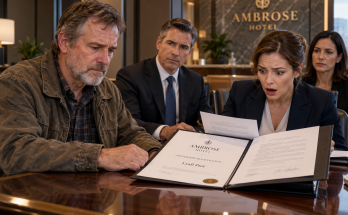
The criminal cases did not end quickly.
Real endings rarely arrive at the pace stories promise.
There were hearings.
Motions.
Negotiations.
More interviews.
More records.
Arguments over which statements could be admitted and which charges the evidence could sustain.
I stopped attending everything.
That surprised Daniel.
“Aren’t you going to the hearing?”
“No.”
“But it’s about Dad.”
“Your father is still dead whether I sit on a wooden bench for six hours or not.”
That sounded harsh.
It was not indifference.
It was recovery.
For months, the investigation had occupied every room of my life.
I had finally learned that knowing the truth did not require living permanently inside the machinery that proved it.
Celeste called when something mattered.
Andrew handled the money.
Marcus finished the evidence work.
I planted tomatoes.
Eileen criticized the tomatoes.
Normal life returned rudely and without ceremony.
Victor Hale eventually faced charges tied to fraud, conspiracy, stolen lottery claims, intimidation, and Harold’s death.
The exact legal outcomes divided responsibility more carefully than my grief ever would.
Travis’s role in forcing Harold’s truck from the road became central.
The recovered vehicle evidence, recordings, witness statements, and Victor’s ledger supported the prosecution.
Melissa’s cooperation reduced some of the uncertainty but did not erase her participation.
She had driven the first vehicle.
She had struck Harold’s truck.
She had taken his phone and folder while he was injured.
She had failed to call for help.
She had forged documents years earlier.
Whatever sentence the court imposed, she would carry those facts longer.
Raymond admitted providing Harold’s location and accepting payment afterward.
His crimes were not identical to Travis’s.
His betrayal was.
He wrote me a letter.
I did not answer.
Not every apology requires a relationship afterward.
Caleb became one of the government’s most useful witnesses.
That did not transform him into a hero.
He had helped steal identities.
Move money.
Hide lottery tickets.
Process fraudulent transactions.
He had protected himself with copies only when he became afraid Victor might sacrifice him.
Still, the evidence he hid inside my birthday card helped expose the entire operation.
Human beings are inconvenient that way.
A coward can preserve evidence.
A criminal can tell the truth.
A person can do one decent thing without becoming decent.
Renata’s case was the hardest for Daniel.
She admitted financial crimes.
Admitted the forged power of attorney.
Admitted manipulating my supposed cognitive decline.
Admitted participating in the pursuit.
Admitted delaying emergency help and concealing evidence afterward.
She continued insisting she never intended Harold to die.
I believed her.
That did not absolve her.
Intent is not magic.
You can destroy someone without waking that morning and deciding to destroy them.
Sometimes all it takes is valuing your own escape more than another person’s safety.
Daniel visited her several times.
He told me only what he wanted to tell me.
I did not ask for more.
That was his relationship to resolve.
Or not resolve.
One evening he sat on my porch and said, “I still love her.”
“I know.”
“You don’t think that makes me stupid?”
“No.”
He looked surprised.
“Love is not evidence of good judgment.”
He laughed.
Then I added, “What you do because of love is where judgment matters.”
His smile disappeared.
“I’m divorcing her.”
“I know.”
“I thought loving her meant I had to protect her.”
“That was your mistake.”
“What should I have protected?”
“The truth.”
He nodded.
After a moment, he said, “Dad figured that out too late.”
“Yes.”
“So did I.”
“Yes.”
“You really don’t soften anything.”
“You are fifty-one.”
“Fair.”
Sophie began therapy.
She hated the word therapy and liked her therapist.
Ethan’s fraudulent credit account was removed from his record after investigators established the identity theft.
He asked me once why his mother would use his name.
I refused to invent an answer.
“You’ll have to ask her someday if you want to know.”
“What do you think?”
“I think people who become comfortable crossing boundaries stop noticing which boundary should have been impossible.”
He considered that.
Then he said, “I’m never giving anybody my Social Security number.”
“Excellent lesson. Slightly broader than necessary.”
He smiled.
The Columbus land survived.
The fraudulent loan claims were challenged.
The mineral rights remained in the separate trust Harold had created for Sophie and Ethan.
Daniel initially wanted nothing to do with the property.
I told him not to make permanent decisions while grieving.
Months later, he visited it.
He walked to Ruth’s springhouse.
Then the creek.
Then the farmhouse.
He called me from the place where Harold had taught him to fish.
“Mom.”
“Yes?”
“I think I’m keeping it.”
“For what?”
“I don’t know.”
“Good.”
He laughed.
“Good?”
“Not every piece of land needs a business plan by Tuesday.”
“I might restore the farmhouse.”
“Then get three estimates.”
“There she is.”
Harold would have approved.
The lottery question took longer.
Margaret Bell’s estate had the strongest evidence.
Her notebook.
The ticket-game description.
The partial serial digits.
Carol Wynn’s admission.
Victor’s records.
Caleb’s messages.
The chain from Sunrise Pines to the convenience store.
Eventually the parties reached a settlement approved through the appropriate legal process.
Margaret’s estate received a substantial share of the remaining prize value.
Laura directed part of it toward family beneficiaries and established a small fund in Margaret’s name supporting residents leaving long-term-care facilities without family assistance.
She called me before finalizing it.
“Do you mind?”
“Why would I?”
“Because your story is tied to Sunrise Pines too.”
I thought about the brochure.
The deposit.
The room Renata had selected without asking me.
“No,” I said. “I think Margaret would like that.”
“And you?”
“I like my yellow house.”
That answer was enough.
I did not end up with the entire eleven million dollars.
Not even close after taxes, legal costs, restitution arrangements, and the settlement.
I remained comfortable.
More than comfortable.
But the exact number stopped mattering.
The money had already purchased the thing I needed most when it arrived.
Choice.
It let me leave Daniel’s house.
Buy my own.
Hire lawyers.
Protect myself.
Investigate without worrying whether I could afford another month.
That mattered.
But money had not solved the mystery.
People did.
Harold first.
Then Sophie.
Eileen.
Celeste.
Andrew.
Marcus.
Investigators.
Laura.
Even reluctant witnesses whose motives were less noble.
Truth arrived through many hands.
One afternoon, almost a year after my birthday, a package arrived from the evidence office.
Inside was the original purple card.
The case no longer required them to keep it.
The scratch ticket itself remained documented elsewhere, but the card came home.
I sat at the kitchen table.
Purple balloons.
Cheap paper.
Renata’s handwriting.
Happy Birthday, Dolores.
Nothing sentimental.
Nothing personal.
Then the little sleeve where the ticket had been tucked.
The glue had been carefully opened during forensic examination.
That tiny space had hidden Caleb’s memory card.
I laughed.
Eileen came in.
“What?”
I held up the card.
“Oh, that ugly thing.”
“Eleven million dollars.”
“Technically less now.”
“Thank you, accountant.”
“You’re welcome.”
She made coffee.
I turned the card over.
“Best birthday present I ever got.”
“That woman tried to put you in a retirement home.”
“Yes.”
“She helped cover up Harold’s death.”
“Yes.”
“She tried to steal your money.”
“Yes.”
“And you’re calling it the best present?”
“The card.”
Eileen stared.
“Explain.”
“It showed me who everyone was.”
She considered that.
Then nodded.
“Expensive lesson.”
“Technically profitable.”
She laughed so hard she had to put down the coffee pot.
Later that week, I visited Lake Arlen.
Daniel came with me.
We had avoided it for years.
Harold’s old fishing cabin had been searched, damaged, and tangled in evidence, but the lake itself remained indifferent.
Water against shore.
Wind through trees.
A dock that needed repairs.
Daniel carried Harold’s restored tackle box.
Blue.
The original.
We sat near the place where Harold had taught him patience.
For a long time, neither of us spoke.
Then Daniel opened the box.
Inside were ordinary fishing things investigators had returned.
Hooks.
Weights.
Old line.
A rusted pair of pliers.
And beneath the tray, one folded piece of paper.
Not evidence.
Not a confession.
A note Harold had written years earlier, probably after a fishing trip with Sophie.
Daniel unfolded it.
“Want me to read it?”
“Yes.”
Harold had written only a few lines.
Danny gets impatient and jerks the line too early.
Sophie waits until the fish nearly steals the rod.
Maybe patience skips a generation.
I laughed.
Daniel covered his eyes.
“That is absolutely something Dad would write.”
“Yes.”
Then he read the final line.
Best things I ever caught came home with me in the car.
Daniel stopped.
His voice broke.
I looked toward the water.
Harold had spent his last years hiding evidence because he believed he had to protect his family from what the truth would do.
In that, he had been partly wrong.
The lies did more damage.
The silence did more damage.
Protecting people from consequences had allowed consequences to grow.
But Harold had corrected himself.
On his final night, he chose to expose everything even though doing so would reveal his own mistakes.
That was his real final gift.
Not land.
Not mineral rights.
Not a hidden vault.
Not a recording.
Permission to stop protecting lies just because the people telling them were family.
Daniel folded the note carefully.
“Mom?”
“Yes?”
“Do you forgive Dad for 1998?”
I thought about the one hundred forty-two thousand dollars.
The twenty-five thousand.
The forged amendment he concealed.
The things he decided without me.
“I forgive him.”
“All of it?”
“No.”
Daniel frowned.
“That doesn’t make sense.”
“It does when you’re older.”
“Mom, I’m fifty-one.”
“Still time.”
He laughed.
Then I explained.
“Forgiveness doesn’t require pretending the wrong thing became right. Your father should have told me. He should have reported what Raymond and Melissa did. He thought preserving the family mattered more.”
“And that helped everything continue.”
“Yes.”
“But you forgive him.”
“Yes.”
“Why?”
“Because I know the whole man.”
Not a saint.
Not a victim carved perfectly from grief.
Harold could be stubborn, secretive, controlling when frightened, and convinced that every problem improved if he handled it alone.
He was also loyal.
Funny.
Careful.
Generous.
And, when the final choice came, brave enough to stop hiding what implicated him too.
Daniel looked toward the lake.
“Do you forgive me?”
I had known the question would arrive eventually.
“Some things.”
He nodded slowly.
“And the rest?”
“I’m working on them.”
“That’s fair.”
“You don’t need my forgiveness to become better.”
He looked at me.
“I want it.”
“I know.”
“Does that matter?”
“Yes.”
“But?”
“But becoming better because you want to deserve forgiveness is different from becoming better because forgiveness is guaranteed.”
He sat with that.
Patience.
Harold would have appreciated it.
Daniel eventually moved into a smaller house.
Not mine.
The rental I owned was sold after the legal complications settled.
Daniel did not ask for special treatment.
I did not offer it.
The proceeds went into my trust.
A portion later helped Sophie with college.
Another helped correct financial damage associated with Ethan’s stolen identity.
No secret transfers.
No hidden arrangements.
Everybody knew.
That became my rule.
If money affected family, the family affected got told.
Revolutionary.
My yellow house became the place people visited instead of the place I escaped to.
Sophie claimed the guest room whenever she came to Georgia.
Ethan complained there was nothing to do and then spent entire afternoons fishing.
Daniel visited carefully at first.
Eventually he stopped asking whether he was allowed to make coffee.
Eileen remained fifteen minutes away and continued entering without sufficient warning.
Life became ordinary.
That was the ending I had wanted without knowing how to ask for it.
Not revenge.
Not eleven million dollars.
Not watching Renata led away in handcuffs.
Ordinary mornings.
Coffee cooling beside an open window.
My own keys on my own table.
Nobody discussing where I should live.
Nobody measuring how much space I occupied.
Nobody keeping a list titled MOM MOVE-OUT.
On my seventy-fourth birthday, Daniel arrived with Sophie and Ethan.
Eileen brought a cake that leaned slightly to one side.
There were no seven candles pretending seventy-four was manageable.
There were two.
One shaped like a seven.
One shaped like a four.
Daniel handed me a card.
I looked at him suspiciously.
“No scratch ticket?”
Everyone laughed.
“Absolutely not,” he said.
“Coward.”
“Traumatized.”
I opened the card.
Inside was a photograph of Harold’s blue tackle box sitting beside the lake.
Underneath, Daniel had written:
For the woman Dad trusted to keep looking.
My eyes filled.
Sophie leaned over.
“Grandma, are you crying?”
“No.”
“You are.”
“I’m seventy-four. My eyes leak.”
Ethan said, “That sounds medically concerning.”
“Eat cake.”
We did.
Later, after everyone left, I sat alone on the porch.
The purple birthday card from the year before was tucked in my desk.
I no longer needed to look at it.
I knew what it had given me.
Not eleven million dollars.
Not exactly.
It gave me the first moment when Renata underestimated me badly enough for me to step outside the life she had planned.
It gave Harold’s evidence somewhere absurd enough to survive.
It connected Margaret Bell to the theft committed after her death.
It exposed Victor’s stores.
It helped investigators identify victims Harold had been trying to protect.
And because I refused to pretend the ticket’s history did not matter, some of what had been taken finally went back where it belonged.
The joke had changed everything.
Just not in the way Renata intended.
Before going inside, I looked toward the darkening street.
For years after Harold died, I believed grief meant carrying unanswered questions forever.
I had been wrong.
Some questions can be answered.
The answers may hurt more than ignorance at first.
They may expose people you love.
They may expose mistakes made by the dead.
They may cost money.
Homes.
Marriages.
Reputations.
Comfort.
But truth does something lies never can.
It lets you decide what happens next.
I had spent four years thinking Harold’s last journey ended against a tree.
Now I understood that the important part of what he started had continued without him.
Through the springhouse.
The blue tackle box.
The recordings.
The victim list.
The ledger.
The birthday card.
Through Daniel finally telling the truth even when it made him look terrible.
Through Sophie refusing to carry her mother’s secret.
Through Margaret Bell’s forgotten notebook.
Through my decision to stop confusing family peace with family silence.
I touched the porch railing.
“Good night, Harold.”
Then I went inside my house.
Mine.
Not because a deed said so.
Not because eleven million dollars had once landed in my hands.
Because nobody else was deciding what room I occupied anymore.
And that, after everything, was the fortune I kept.
The End
Read more original stories on Feel Every Story.
A Two-Dollar Birthday Joke Made Everyone Laugh Until I Realized My Daughter-in-Law Had Handed Me Something Dangerous
Part 26 of 26