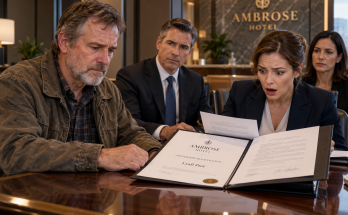
Robert did not deny the signature.
That was almost insulting.
After Grant showed him the document, he lowered his head and said, “Yes.”
I sat across from him again.
This time I felt no need to search his face for the father I remembered.
“What did you think you were signing?”
His attorney advised him not to answer.
Robert answered anyway.
“A bridge authorization.”
“What does that mean?”
“Linda said the money would leave your account temporarily, secure the Greenwich property, then be replaced after financing.”
“So you knew.”
“Yes.”
“You knew she was taking $960,000 from me without asking.”
“Yes.”
“And the morning I discovered it, you stood in the kitchen and told me to calm down.”
His eyes closed.
“Yes.”
“Why?”
“Because I thought I could put it back.”
“With what?”
“My money.”
“Seven million dollars that Jackson had already arranged to move if the purchase failed.”
Robert stared.
He had not known that part.
I almost laughed.
Everyone was stealing from everyone.
“You were going to repay theft with money your son was preparing to steal from you.”
Robert rubbed his face.
“I didn’t know.”
“That sentence has done a lot of work for you.”
He nodded.
“I deserve that.”
“This isn’t about what you deserve.”
I slid the document toward him.
“This is about what you chose.”
Linda had asked him to sign.
He knew I had not approved the transfer.
He signed anyway because he believed the money would return before I noticed.
The same logic Jackson used.
The same logic Linda used.
Emily will recover.
Emily has enough.
Emily won’t fight.
My competence had become their permission slip.
“Why the Greenwich house?”
“Linda said buying it would end everything.”
“How?”
“She believed the original trust records hidden there could be destroyed.”
“So you knew she wanted evidence.”
“Yes.”
“And you still signed.”
“Yes.”
“Did you know Charles was involved?”
“Not then.”
“Did you know Jackson was?”
“I knew he wanted the house.”
“That wasn’t my question.”
Robert looked at the document.
“Yes.”
The answer ended something.
Not affection.
That would take longer.
But ambiguity.
Robert had not merely failed to stop Linda.
He participated.
He knew enough.
He chose enough.
His eventual cooperation mattered legally.
It did not rewrite the choice.
“I won’t visit you in prison.”
His face tightened.
“I understand.”
“I’m not saying never.”
Hope appeared.
I corrected it.
“I’m saying I’m not promising anything.”
He nodded.
“That’s fair.”
“No.”
He looked at me.
“It’s mine.”
He understood.
“Yes.”
Robert’s plea agreement required surrendering assets, testifying against Charles and Linda, identifying hidden accounts, and accepting a prison sentence.
He did all of it.
The prosecution recommended consideration for cooperation.
Not absolution.
His sentencing would come later.
Linda’s case moved faster because the evidence was overwhelming and her attorney knew a trial could expose her to even more severe penalties.
Fraud.
Identity theft.
Conspiracy.
Obstruction.
Attempted destruction of evidence.
Participation in the attack on Rebecca.
And attempted murder-related charges arising from the boat sabotage and hospital confrontation.
Her plea negotiations lasted weeks.
I tried to return to work during that period.
My first morning back, I sat at my desk for twenty minutes before opening email.
No one knew what to say to me.
Colleagues had seen news reports.
Most details were sealed, but enough had become public.
Fraud investigation.
Family trust.
Multiple arrests.
False identities.
I received careful messages.
Thinking of you.
Take whatever time you need.
No need to respond.
I appreciated the ones that did not ask questions.
Work felt strange.
Also useful.
A spreadsheet behaved like a spreadsheet.
A meeting began when scheduled.
A contract meant what its clauses said unless someone committed fraud.
Normality had become luxurious.
Rebecca remained nearby but did not force contact.
We had coffee twice.
The first time we discussed nothing personal.
The second time she told me about Canada.
She had lived in Montreal, then Lyon, then briefly Brussels.
She worked under variations of her middle name.
Never married.
Never had another child.
I did not ask whether that was because of me.
I was learning not every silence required immediate excavation.
Marcus returned to his bank in a different department while internal investigators reviewed Daniel Cole’s access.
He had been formally cleared of involvement.
He texted occasionally.
Never “daughter.”
Never “love.”
Usually practical things.
Did you eat?
Your attorney sent the revised trust schedule.
The bank restored the reserve authorization.
One afternoon he brought a small plastic bag to my apartment.
Inside was a hospital bracelet.
His name was not on it.
Mine was not either.
Just a date and the notation BABY GIRL W.
“I kept this?”
“I thought it was yours.”
He had received it from a hospital employee after being told Rebecca’s baby died.
Arthur’s people had given Marcus a false death certificate.
He believed he had buried an infant daughter.
The casket had been empty.
The parallel to Rebecca’s empty funeral years later was unbearable.
“Did you go to the funeral?”
“Yes.”
“Who arranged it?”
“Victor.”
Of course.
Marcus looked at the bracelet.
“I kept it because it was the only thing I had.”
I handed it back.
“You should keep it.”
“I thought you might want it.”
“Maybe someday.”
He nodded.
No offense.
No claim.
We were becoming good at not forcing meaning.
Linda requested to speak with me before entering her final plea.
I declined.
She requested again before sentencing.
I declined again.
Then her attorney sent a letter.
I did not open it for three days.
When I finally did, it was shorter than expected.
Emily,
I know I have no right to ask you to speak for me. I am asking anyway. Tell the judge I raised you. Tell the judge there were years when I was your mother in every way that mattered. I know what I did with your money was wrong. I know I lied. But thirty-three years cannot be reduced to my worst choices.
Linda
I read it twice.
Then put it away.
She was right about one thing.
Thirty-three years could not be reduced to her worst choices.
They also could not be used to erase them.
At sentencing, the courtroom was full.
Reporters occupied the back benches.
Linda wore dark blue.
Her hair was neat again.
For a moment she looked like the woman who used to sit across from me at birthday dinners and complain that restaurants were too loud.
Jackson was not present.
Robert was not present.
Rebecca sat several rows behind me.
Marcus beside her.
Khloe came too.
The prosecutor described the scheme in precise language.
Years of unauthorized transfers.
Identity misuse.
Trust manipulation.
Forged signatures.
Efforts to destroy evidence.
Payments connected to Rebecca’s boat sabotage.
The planned escape.
The hospital confrontation.
The attempt to use my wedding expenses and emotional pressure as cover.
Linda’s attorney described her cooperation after arrest.
Her age.
Her lack of prior convictions.
Her role raising two children.
Then he said my name.
I felt Rebecca shift behind me.
The judge asked whether I wished to make a victim-impact statement.
I stood.
“No, Your Honor.”
Linda turned.
Our eyes met.
I had prepared nothing.
That was intentional.
I would not convert my life into a performance so she could use my pain either for mercy or punishment.
The judge asked whether I wanted the court to consider the letter Linda had submitted describing our relationship.
“My attorney has already provided the financial and factual record.”
“That wasn’t my question.”
I understood.
“No. I do not want to make a recommendation about her sentence.”
Linda’s face fell.
I continued.
“I spent most of my life being asked, directly or indirectly, to carry responsibility for keeping my family together. I don’t want that responsibility here.”
The courtroom was completely silent.
“The court has the evidence. She made her choices. I’m asking that the sentence be based on those choices, not on whether I can forgive them.”
The judge nodded.
“Thank you.”
I sat.
Linda cried quietly.
I did not.
Her plea covered fraud, identity theft, conspiracy, obstruction, and attempted murder-related conduct connected to Rebecca’s sabotage and the later armed confrontation.
The sentence was long.
Long enough that age made its meaning obvious.
Linda would spend much of the rest of her life in prison.
She did not collapse.
She did not shout.
When deputies approached, she looked at me.
“Emily.”
I remained seated.
“I’m sorry.”
I believed she was.
That did not require me to rescue her from consequence.
The deputies turned her toward the exit.
She took two steps.
Then stopped.
“I did love you.”
The same sentence from St. Catherine’s.
This time I answered differently.
“I loved you too.”
She closed her eyes.
I continued.
“That’s why this mattered.”
She nodded once.
Then they took her away.
Outside the courthouse, reporters waited.
I used a side exit.
Khloe walked with me.
Rebecca and Marcus remained several paces behind.
No one touched me.
No one told me I had been brave.
I was grateful.
At the car, Khloe asked, “Do you feel better?”
“No.”
“Worse?”
“No.”
“What then?”
I thought about it.
“Finished with that part.”
She nodded.
That was enough.
Jackson’s plea came next.
His cooperation against Charles, disclosure of hidden companies, assistance locating Teresa, and admission regarding Khloe’s forged documents reduced his exposure.
It did not eliminate prison.
He accepted the agreement.
Khloe testified about the false marital amendment.
I testified about the copied catering signature and rehearsal documents.
Jackson apologized in court.
Not to the room.
To us.
“Emily, I treated your ability to recover as permission to hurt you. Khloe, I treated loving you as if it gave me rights over what belonged to you. It didn’t.”
He stopped there.
No request for forgiveness.
The judge sentenced him.
Shorter than Charles would likely receive.
Longer than Jackson had hoped.
Afterward, his attorney asked whether I would see him before transport.
I almost said no.
Then I went.
Jackson sat behind glass.
For a moment we were children again in my mind.
He was nine, asking me to help with homework.
Fourteen, calling because he had missed the bus.
Twenty-two, asking for money after another business idea collapsed.
Then the image disappeared.
“You came.”
“Yes.”
He looked at me.
“Are you ever going to forgive me?”
“I don’t know.”
He nodded.
“I think that’s fair.”
I almost corrected him as I had Robert.
Instead I said, “Stop deciding what’s fair for me.”
A small smile.
“Right.”
“Khloe got the annulment.”
“I know.”
“She doesn’t want contact.”
“I know.”
“Respect that.”
“I will.”
“And stop asking Dad to contact her for you.”
His expression showed surprise.
“How did you—”
“She told me.”
He looked embarrassed.
“I’ll stop.”
Good.
I stood.
“Emily.”
I waited.
“Were we ever really brother and sister?”
The question hurt more than I expected.
Biologically, no.
Legally, complicated.
Emotionally, painfully yes.
“You were my little brother every day I knew you.”
His eyes filled.
“Was?”
“I don’t know what you are now.”
He looked down.
“That’s fair.”
I let it go.
Then he said something I carried with me.
“Charles taught me that if somebody has more than you, taking from them isn’t really stealing.”
I waited.
“Mom taught me you would always survive.”
“And what did Dad teach you?”
Jackson thought.
“That if you wait long enough, someone else will make the hard decision.”
I looked at him.
“And what did I teach you?”
He gave a sad laugh.
“Apparently that people eventually stop paying.”
I left.
Outside, Grant was waiting.
Charles’s prosecutors had finished reviewing the evidence from the Maine farmhouse, Victor’s wreck, St. Catherine’s, and Daniel’s laptop.
The case against him now included fraud, conspiracy, identity theft, kidnapping-related charges, attempted murder, obstruction, and evidence connected to Victor’s death.
But one question remained.
Rebecca’s boat sabotage.
They had payments.
They had Linda’s admissions.
They had circumstantial evidence.
They needed the person Charles had hired.
Grant held out a photograph.
I recognized the face.
Not from family albums.
From the wedding.
The man had worked security at the coastal villa.
He had stood near the entrance while I signed the catering agreement.
He had access to guest rooms.
He had access to documents.
And twelve years earlier, he had worked as a marine mechanic in Maine.
Name:
Caleb Price.
Charles had used the same man who sabotaged Rebecca’s boat as security at Jackson’s wedding.
Not because he needed protection.
Because if the wedding plan failed, Caleb was supposed to create another accident.
Grant showed me the final payment instruction.
Contingency target:
Emily Wilson.
The method:
Vehicle failure on coastal road.
The transfer was not the only danger waiting for me the morning after the wedding.
If I had left the villa quietly instead of calling the bank and police, Caleb was supposed to follow me.
Charles had planned two endings.
Either I stayed silent and signed away control.
Or I died before I could challenge it.
Grant said Caleb had been arrested an hour earlier.
He was cooperating.
I looked back toward the courthouse where Linda had been sentenced and Jackson had entered his plea.
For days I had wondered whether calling the bank had started the destruction of my family.
Now I understood the opposite.
Calling the bank had probably saved my life.
The first decision I made after seeing $960,000 disappear had been the simplest one.
I refused to pretend it was normal.
Everything that followed began there.
And for the first time, the evidence showed exactly what that refusal had prevented.
Click here to continue reading: PART 21: Caleb’s Testimony Proved My Death Was a Wedding Contingency, but Charles’s Trial Finally Separated His Crimes From the Stories He Used to Justify Them
The Morning After My Brother’s Wedding, One Missing Number Turned Every Family Favor I Had Ever Made Into Evidence
Part 20 of 24