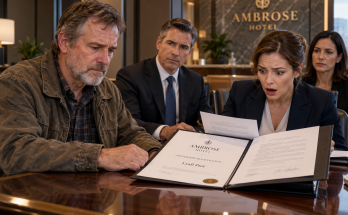
Caleb Price did not look like the man I remembered from the wedding.
That night he had worn a dark suit and an earpiece, standing near the villa entrance with the bland attentiveness of hired security. I had passed him carrying champagne. I had probably thanked him.
Now he wore county-issued clothes and handcuffs.
Detective Grant warned me before his interview that cooperation did not make him sympathetic.
“I wasn’t planning to confuse the two.”
She nodded.
By then, I had become good at separating explanation from excuse.
Caleb began with Rebecca.
Twelve years earlier, Charles paid him to damage the fuel line on her boat.
Linda supplied the marina schedule.
Robert did not know about the sabotage beforehand.
Victor was already dead by then, though Charles was still living publicly under Victor’s identity.
“What were you told?” Grant asked.
“That Rebecca was blackmailing the family.”
“And you agreed to kill her?”
Caleb looked down.
“I was told the failure would happen close to shore.”
Rebecca sat behind the observation glass with me.
She whispered, “It didn’t.”
No.
She had smelled fuel.
Jumped.
Nearly drowned.
Been rescued by a fisherman.
Then allowed the world to bury an empty coffin because she believed the people who tried once would try again.
Caleb admitted Charles paid him $180,000.
Linda paid another $40,000 through a company later absorbed into Willow Crest.
“What happened when Rebecca survived?”
“I didn’t know she survived.”
“Charles?”
“He suspected.”
That explained the years of monitoring.
Charles had never been certain Rebecca was dead.
He simply found her absence useful.
Then Grant moved to Jackson’s wedding.
Caleb had been hired through the villa’s security contractor.
Charles arranged it.
His job had three stages.
First, photograph any documents I signed.
Second, monitor whether I discovered the $960,000 transfer.
Third, if I left the villa after refusing the family’s explanation, follow me.
“What were you supposed to do?”
Caleb stared at his hands.
“Damage the steering linkage while her car was parked.”
Rebecca inhaled sharply.
I felt almost nothing.
Perhaps there was a limit to how many planned deaths a person could discover before the body stopped reacting properly.
“When?”
“The morning after the wedding.”
“Before or after Emily discovered the transfer?”
“After.”
“How would you know?”
“Linda would message.”
My mother—the woman I had called Mom—had possessed a code that could initiate an attempt on my life.
Grant asked whether Linda knew what the code meant.
Caleb hesitated.
“Yes.”
Rebecca stood and left the observation room.
I remained.
“What was the code?” Grant asked.
“Family first.”
Of course.
I closed my eyes.
Three words that had probably been spoken in our house a thousand times.
At birthdays.
At holidays.
Whenever Jackson needed money.
Whenever I objected.
Family first.
Charles had turned it into an instruction to kill me.
“What stopped you?”
Caleb swallowed.
“Emily didn’t leave.”
Because I called the bank.
Because Marcus froze the transfer.
Because Grant became involved.
Because Khloe started asking questions.
Because the villa filled with conflict instead of dispersing after breakfast.
Caleb never got the opportunity.
Then police arrived.
He abandoned the plan.
“Did Linda send the code?”
Grant asked it carefully.
Caleb looked at me through the glass.
Then answered.
“No.”
That surprised me.
“She didn’t?”
“No.”
“Did Charles?”
“Yes.”
“When?”
“About forty minutes after Emily called the bank.”
Linda had known the contingency existed.
She had helped create the infrastructure around it.
But when the moment came, she had not activated it.
Charles had.
It changed one detail.
Not the larger truth.
Linda had participated in Rebecca’s sabotage.
She had concealed fraud.
She had helped Charles for years.
She had known an accident contingency existed for me and failed to warn me.
Choosing not to send the final message did not make her innocent.
Still, facts mattered even when they complicated anger.
I asked Grant if Linda’s attorneys knew.
“They will.”
“Could it change her sentence?”
“Probably not substantially.”
I nodded.
That was not why I asked.
I simply did not want to become like them.
I did not want the version of events that hurt most to become automatically preferable to the version supported by evidence.
Charles’s prosecution absorbed Caleb’s testimony.
So did the investigation into Victor’s death.
The preserved tissue from the body recovered after the old boat fire finally produced usable DNA.
It matched Elena and me as our biological father.
Victor Shaw had died that night.
The corpse had been Victor.
The identification as Charles had been fraudulent.
That ended the last uncertainty about my paternity.
Victor was my biological father.
Marcus was not.
No more letters.
No more altered records.
No more guesses.
Science did not make the truth pleasant.
It made it stable.
Evidence from Victor’s recovered documents, Teresa’s testimony, Caleb’s information, and Charles’s financial records built the murder case.
Charles had arranged modifications to Victor’s boat.
Not the same crude fuel-line sabotage used against Rebecca.
Something subtler.
A ventilation fault designed to allow fumes into the engine compartment.
The resulting fire looked accidental.
Victor had discovered enough to suspect him, which was why he left the marine camera and waterproof records.
Charles killed Victor, placed identification supporting the false Charles identity, then gradually assumed Victor’s legal existence.
It was grotesque.
Also methodical.
Charles’s attorneys tried to separate the financial crimes from the death.
The prosecutors refused.
Identity theft was not merely how he stole money.
It was how he concealed murder.
The trial began months later.
By then, Linda was serving her sentence.
Jackson had begun his.
Robert was awaiting final sentencing after completing cooperation.
Daniel Cole had accepted a plea arrangement covering unauthorized system access, fraud, and conspiracy.
His cooperation became extensive after learning about the Hale-Wilson trust.
He surrendered credentials, explained Charles’s digital methods, and helped restore compromised banking records.
Ethan Cole pleaded guilty to accepting payment to help Jackson escape detention.
Khloe’s annulment was final.
Elena returned to Vermont with Teresa.
Rebecca moved into a small apartment fifteen minutes from mine.
Not with me.
That distinction mattered.
Marcus remained nearby too.
No one had transformed into a happy family.
We were simply becoming people who could occupy the same room without lying about who anyone was.
At Charles’s trial, I testified for nearly four hours.
His attorney asked whether I personally saw Charles forge my signature.
“No.”
“Did you personally see him authorize the $960,000 transfer?”
“No.”
“Did you see him sabotage Rebecca Wilson’s boat?”
“No.”
“Did you see him kill Victor Shaw?”
“No.”
“So much of what you believe about my client comes from what other people told you.”
“Much of what I know comes from documents.”
He paused.
“Documents can be forged.”
“Your client certainly proved that.”
The prosecutor objected.
The judge sustained.
I apologized.
I was not particularly sorry.
Charles watched me from the defense table.
He looked older.
Not defeated.
Just finally forced to exist under one name.
Charles Shaw.
Not Victor.
Not an anonymous investor.
Not a man supposedly dead.
Charles.
Caleb testified.
Teresa testified.
Rebecca testified about the night Victor died and her own sabotaged boat.
Marcus explained the bank structures but carefully separated what he knew professionally from what he knew personally.
Daniel testified against his biological father.
That was the testimony Charles reacted to most.
Daniel described being recruited without knowing Charles was his father.
He described the lies about Victor.
The hidden trust.
The false beneficiary verification.
Then the prosecutor asked why he ultimately cooperated.
Daniel looked at Charles.
“Because he spent my whole life telling me family meant blood, then hid my blood whenever it was inconvenient.”
Charles looked away.
The jury deliberated for three days.
Guilty.
Count after count.
Fraud.
Identity theft.
Conspiracy.
Kidnapping-related offenses.
Attempted murder.
Obstruction.
And murder in Victor’s death.
Rebecca sat beside Elena when the verdict was read.
I sat beside Khloe.
Marcus behind us.
None of us celebrated.
The result was not victory.
Victor remained dead.
Rebecca still lost decades.
Elena grew up without knowing her father.
Daniel had been turned into an instrument.
Jackson had become both participant and victim and then participant again.
I had lost the family history I thought belonged to me.
A verdict could assign responsibility.
It could not return time.
At sentencing, Charles finally spoke.
He described Thomas Vale.
Arthur Wilson.
The partnership.
The humiliation he believed his father endured.
The wealth Arthur accumulated.
The opportunities Charles believed the Wilson family stole.
Then he looked at me.
“You sit there because your grandfather won.”
I surprised myself by answering before the judge stopped me.
“No.”
The courtroom went quiet.
Charles frowned.
“Arthur didn’t win.”
The judge told me not to engage.
I nodded.
But the sentence had already escaped.
Arthur manipulated Rebecca.
Destroyed Marcus’s career.
Helped separate me from my mother.
Created money to repair damage money could not repair.
Victor committed terrible crimes.
Linda committed hers.
Robert made cowardice into policy.
Jackson chose theft after learning theft had shaped his childhood.
Charles chose to make all of it worse.
There was no winning side.
Only people who inherited damage and decided whether to continue it.
The judge imposed a sentence Charles was unlikely ever to outlive.
When deputies led him away, he did not look at Daniel.
He looked at me.
I did not look away.
Afterward, Grant met us on the courthouse steps.
“This should be the last major criminal proceeding.”
“Should?”
She smiled.
“Law enforcement learns not to promise.”
I almost laughed.
Then she handed me a folder.
Final forensic accounting.
The numbers had stabilized.
Arthur’s trust, after recovered assets, taxes, penalties, restitution, and valid third-party claims, retained slightly more than twenty-four million dollars.
Half Rebecca.
Half me.
The larger Hale-Wilson Custodial Trust had also been validated.
Charles’s management election was void.
The fraudulent Elena approval was void.
Daniel revoked his Archer Seven vote.
All beneficiaries selected independent institutional management.
The trust would be divided according to Victor’s instructions among Elena, Daniel, Rebecca, and me, subject to final tax treatment.
I closed the folder.
Grant studied me.
“You’re not going to ask how much?”
“No.”
“Progress.”
“I’m terrified that you think you know me well enough to say that.”
“I have read eleven thousand pages about your family.”
“Fair.”
She became serious.
“What will you do now?”
It was the question everyone kept asking.
With the money.
With Rebecca.
With Marcus.
With Robert.
With Jackson.
With my name.
With everything.
“I don’t know.”
Grant nodded.
“Good.”
I looked at her.
“That may be the first answer no one in your family prepared for you.”
She was right.
For once, uncertainty did not feel dangerous.
It felt like space.
Click here to continue reading: PART 22: Robert Went to Prison Without Asking Me to Call Him Dad, and the Greenwich House Finally Left Our Family Without Taking Me With It
The Morning After My Brother’s Wedding, One Missing Number Turned Every Family Favor I Had Ever Made Into Evidence
Part 21 of 24